

If you buy from the TMN online shop at Amazon, we get 15 percent of the purchase price. Once you are in the shop, you can search for any product sold at Amazon. Shop online at Amazon and help support TMN at the same time!
Gather at S.H.A.P.E. Harambee Building, 3903 Almeda Road (Map)
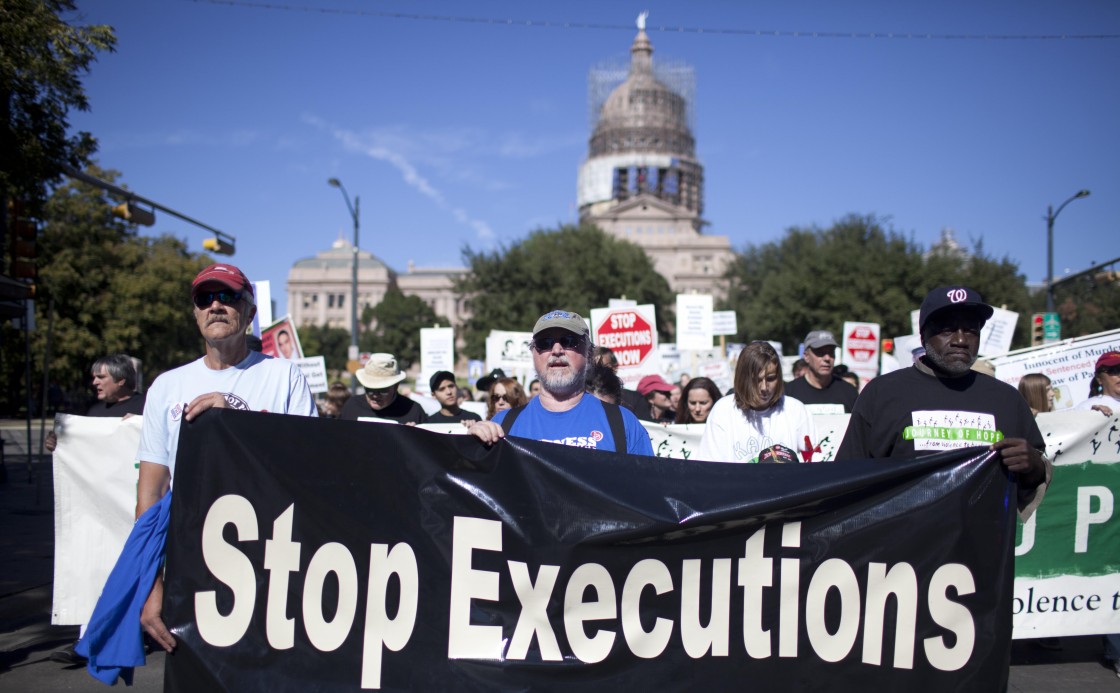
March to S.H.A.P.E. Community Center, 3815 Live Oak The March to Stop Executions has been held each October since 2000. It is cosponsored by the Texas Death Penalty Abolition Movement, Texas Moratorium Network, the Austin chapter of the Campaign to End the Death Penalty, Texas Students Against the Death Penalty and others. Event on FacebookScheduled Executions in Texas
Jeff Wood Was Granted a Stay of Execution By a Federal Judge
More information on the stay: "With all due respect, a system that requires an insane person to first make 'a substantial showing' of his own lack of mental capacity without the assistance of counsel or a mental health expert, in order to obtain such assistance is, by definition, an insane system," U.S District Court Judge Garcia wrote in the order issuing the stay.
Thank you to everyone who called or emailed the Governor and Board of Pardons and Paroles!
Jeff Wood is waiting to die on Texas Death Row. Jeff was charged under the Law of Parties, and was not the shooter in this crime. Jeff could not anticipate that a murder would occur.The actual shooter in this case has already been executed by the state of Texas.
The above video is an episode of the ACLU's Freedom Files, featuring TMN's former chairperson Jeanette Popp
Posted by admin on: Wednesday 06 August @ 02:37:12
Section 7.02 of the Texas Penal Code outlines the following:
A person is criminally responsible for an offense committed by the conduct of another if "acting with intent to promote or assist the commission of the offense he solicits, encourages, directs, aids or attempts to aid the other persons to commit the offense" or "If, in the attempt to carry out a conspiracy to commit one felony, another felony is committed by one of the conspirators, all conspirators are guilty of the felony actually committed, though having no intent to commit it, if the offense was committed in furtherance of the unlawful purpose and was one that should have been anticipated as a result of the carrying out of the conspiracy." Article 37.071(b)(2) of the Code of Criminal Procedures permits the infliction of the death penalty only if the jury believes beyond a reasonable doubt that the defendant "intended to kill the deceased or another or anticipated that a human life would be taken."
PARTIES AND THE US SUPREME COURT The US Supreme Court held that imposition of the death penalty on a person who aids and abets a felony in the course of which a murder is committed by others but who does not himself kill, attempt to kill, or intend to kill violates the 8th and 14th Amendments of the US Constitution. (Edmund v. Florida 458 US 782, 1982) Five years after the Edmund decision the Supreme Court created an exception to this general rule for those guilty of a murder that occurs in the commission of a felony who do not kill or intend to kill, but who have major personal involvement in the felony and display a reckless indifference to human life. (Tison v. Arizona, 481 US 137, 1987)
THE STANDARD NECESSARY TO DEMONSTRATE RECKLESS INDIFFERENCE TO HUMAN LIFE The Delaware Superior Court observed: "Major participation and reckless indifference to human life are more likely to be found where an accomplice defendant is present at and before a killing which involved considerable deliberation and the killing is preceded by physical or psychological abuse of the victim, including assault, torture or other acts of cruelty. Such a finding is less likely where the killing is sudden or impulsive and it is unclear that the defendant actually caused the victim’s death."
The application of Texas Penal Code 7.02, in combination with Texas Code of Criminal Procedures Article 37.071(b)(2), is unjust and unconstitutional because it permits the death penalty to be imposed for complicity in a capital crime without requiring a finding that the person intended to kill or that he was a major participant in a crime where he showed reckless disregard for human life. In other words, neglecting to anticipate another actor’s commission of murder in the course of a felony is all that is required to make a Texas defendant death-eligible, thus immensely lowering the standard the US Supreme Court has set. This is allowing the death penalty to be applied in a most immoral and liberal way
HUNTSVILLE, Tex. — Here in the nation’s leading death-penalty state, and some of the 35 others with capital punishment, execution dockets are quickly filling up.
Less than three weeks after a United States Supreme Court ruling ended a seven-month moratorium on lethal injections, at least 14 execution dates have been set in six states between May 6 and October.
“The Supreme Court essentially blessed their way of doing things,” said Douglas A. Berman, a professor of law and a sentencing expert at Ohio State University. “So in some sense, they’re back from vacation and ready to go to work.”
Experts say the resumption of executions is likely to throw a strong new spotlight on the divisive national — and international — issue of capital punishment.
“When people confront a new wave of executions, they’ll be questioning not only how people are executed but whether people should be executed,” said James R. Acker, a historian of the death penalty and a criminal justice professor at the State University at Albany.
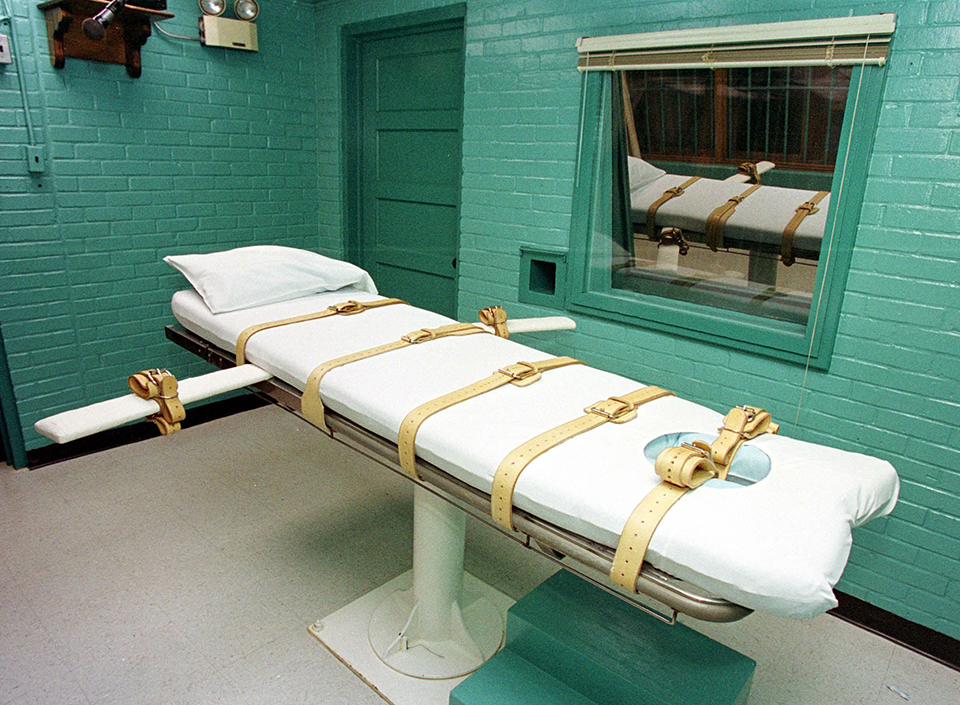
Texas leads the list with five people now set to die here in the Walls Unit, the state’s death house, between June 3 and Aug. 20. Virginia is next with four. Louisiana, Oklahoma and South Dakota have also set execution dates.
Some welcome the end of the moratorium.
“We’ll start playing a little bit of catch-up,” said William R. Hubbarth, a spokesman for Justice for All, a victims rights group based in Houston.
“It’s not like we have a cheering section for the death penalty.” Mr. Hubbarth said. But, he added: “The capital murderers set to be executed should be executed post-haste. It’s not about killing the inmate. It’s about imposing the penalty that 12 of his peers have assessed.”
More inmates whose appeals have expired are certain to be added to execution rosters soon, including, in all likelihood, Jack Harry Smith, who, at 70, is the oldest of the 360 men and 9 women on Texas’ death row (though hardly a row any more, but an entire compound). Mr. Smith has been under a death sentence for 30 years for a robbery killing at a grocery in the Houston area.
“If it’s my time to go, it’s my time to go,” said Mr. Smith, who maintains his innocence and was delivered by guards for a prison interview in a wheelchair.
So far, at least nine others elsewhere, including Antoinette Frank, a former police officer convicted of a murderous robbery rampage in New Orleans, have been given new execution dates, according to the Death Penalty Information Center, an anti-capital punishment research group that puts the latest death row census at 3,263. Dozens more are likely to get execution dates in coming months, but most under death sentences have not exhausted their appeals.
Yet public support for capital punishment may be dwindling. Death sentences have been on the decline, and a poll last year by death penalty opponents found Americans losing confidence in the death penalty.
“There will be more executions than people have the stomach for, at least in many parts of the country,” said Stephen B. Bright, president of the Southern Center for Human Rights in Atlanta, a leading anti-death-penalty litigation clinic.
Last year, Texas accounted for 26 of the 42 executions nationwide. That includes the last two people executed before the Supreme Court signaled a moratorium on executions while considering whether the chemical formula used for lethal injection in Kentucky inflicted pain amounting to unconstitutionally cruel and unusual punishment. The justices ruled 7 to 2 on April 16 that it did not, while allowing for possible future challenges.
But the scheduling of executions comes as prosecutors and juries have been turning away from the death penalty, often in favor of life sentences without parole, now an option in every death-penalty state but New Mexico.
According to the Death Penalty Information Center, death sentences nationwide rose from 137 in 1977, peaked at 326 in 1995 and fell steadily to 110 last year.
“We’re seeing a huge drop-off,” said Mr. Bright, attributing the decline to the time and trouble of imposing death sentences, and a recent wave of exonerations after DNA tests proved wrongful conviction.
Close to 35 people have been cleared in Texas alone, including, just days ago, James L. Woodard, who spent more than 27 years in prison for a 1980 murder he did not commit.
The first inmate now set for execution is William E. Lynd, 53, on Tuesday in Georgia. Mr. Lind was convicted of shooting his girlfriend, Ginger Moore, in the face during an argument in 1988, shooting her again as she clung to life, and a third time, fatally, as she struggled in the trunk of his car. After burying her, he attacked and killed another woman he had stopped on the road.
With two other executions pending but not yet scheduled in Georgia, the state seeks “clearance of the backlog,” said Russ Willard, a spokesman for Attorney General Thurbert E. Baker. “We will work our way though the system at a much more rapid pace than we would have.”
Virginia — which has executed 98 people since 1976, second only to Texas, with 405 — has the next scheduled execution: May 27, for Kevin Green, 30, for the 1998 slayings of Patricia and Lawrence Vaughn in their convenience store in Dolphin. Three other Virginia inmates also have been given dates in June and July.
Louisiana has set a July 15 execution date for two inmates, including the former police officer, Ms. Frank, 30. She was convicted of killing a fellow officer, Ronald Williams, and two Vietnamese workers, Ha Vu and her brother, Cuong Vong, at their family’s restaurant in New Orleans during a robbery in 1995.
But appeals may delay her execution and that of the second inmate Darrell Robinson, convicted of killing four people.
South Dakota, which has recorded only 15 executions since 1889, set a week’s window of Oct. 7-13 for the execution of Briley Piper, 25. He pleaded guilty to the torture murder of Chester Allan Pogue, 19, who was forced to drink hydrochloric acid and then stabbed and bludgeoned to death in 2000. One accomplice was executed last year and another is serving life without parole.
The first Texas inmate now re-scheduled for death, on June 3, is Derrick Sonnier, 40, convicted of stalking, stabbing and strangling a young mother, Melody Flowers, and her baby son in Humble, north of Houston, in 1991.
Mr. Sonnier, who turned down a request this week for an interview, had forbidden his trial lawyer from calling family members as mitigating witnesses, costing him a chance for life in prison without parole, said his appellate lawyer, Jani Maselli.
After 7 months without executions, Texas has scheduled two people for execution. Meanwhile, we are still waiting on a response from the State Commission on Judicial Conduct to the complaint against Judge Sharon Keller that we sent them that was signed by around 1900 people regarding Keller's unethical behavior on Sept 25, the last time a person was executed in Texas and in the entire U.S.
From the Houston Chronicle:
At least two condemned Texas inmates already have execution dates following last week's U.S. Supreme Court ruling upholding the lethal injection process.
Charles Dean Hood, convicted of a double slaying in the Dallas suburb of Plano more than 18 years ago, and Larry Donnell Davis, condemned for a 1995 robbery-slaying in Amarillo, are set to die, said the Texas Attorney General's Office, which handles federal appeals involving capital murder cases.
Hood, 38, was set for lethal injection June 17 by State District Judge Curt Henderson. Davis, 40, was set to die July 31 by State District Judge John Board.
Aims to speed up execution Selwyn Davis expected to pursue only a required appeal.
By Steven Kreytak AMERICAN-STATESMAN STAFF Tuesday, April 08, 2008
In a move that could trim his stay on Texas' death row from the norm of about 10 years to less than two, condemned killer Selwyn P. Davis wants to waive most of his appeals, according to his lawyer.
Ariel Payan, Davis' appeals lawyer, declined to say why Davis doesn't want to carry out all of his appeals.
During his October trial in Travis County, Davis' lawyers said he conceded that he fatally stabbed Regina Lara, his ex-girlfriend's mother, at her 381/2 Street apartment. But they argued that his crime was not committed in the course of a burglary and robbery, as charged, and that therefore it didn't fit Texas' definition of capital murder.
Davis killed Lara during a two-day crime spree that began when he beat his ex-girlfriend, fracturing her eye socket, and poured rubbing alcohol over her head and threatened to set her on fire, according to testimony. During the capital murder trial, Davis stuck his middle finger up at Lara's family.
It is uncommon for death row inmates to waive their appeals, and some defendants who initially say they don't want to appeal change their minds, according to death penalty lawyers. These include William Murray, a North Texas man condemned in 1998.
Murray, convicted of killing an elderly woman in Kaufman, said in 1999 that he wanted his execution expedited. He is still on death row after years of appeals, including a legal fight to reinstate his appellate rights.
Just over a year after Angel Maturino Resendiz was sentenced to death in 2000 for killing a Houston doctor, the confessed serial killer acknowledged his guilt and said he wanted to waive his appeals in the case. But his mental competency to do so was questioned, and a series of appeals was eventually filed on his behalf. He was executed in 2006.
The average stay on Texas' death row is 10 years and three months, according to the Texas Department of Criminal Justice. Since Texas reinstated the death penalty in the early 1980s, the inmate with the shortest stay on death row before execution was Joe Gonzales, who was executed in 1996 after eight months there. Gonzales, a roofer, was convicted in Potter County of the murder and robbery of his boss in Amarillo and waived his appeals.
Davis, 26, was sent to death row in Livingston from Travis County on Oct. 17, 2007, two days after his death sentence was announced. On Nov. 20, he wrote the Texas Court of Criminal Appeals a letter.
"I would like to cancel my appeals," the letter said, in part. "All of them!"
Last month, the court entered an order stating that Texas law guarantees a review by the Court of Criminal Appeals of a death penalty conviction and sentence. Payan said Davis has agreed to cooperate in that so-called direct appeal. But Payan said that Davis wants to waive his right to file applications for writ of habeas corpus in federal and state courts, the process by which inmates can challenge the legality of their incarceration.
That process, which takes years to run its course, can be waived.
Once briefs are filed by Davis and the state in the direct appeal, the Court of Criminal Appeals is under no time limit to issue an order. Payan said some decisions are reached within months and others take years. He estimates the quickest Davis' case could be disposed on appeal and ready for an execution date would be in a year and a half.
Executions in Texas have been on hold since September as the U.S. Supreme Court considers the constitutionality of lethal injection. A decision is expected this summer.
Davis is in the Travis County Jail and will appear Friday before state District Judge Julie Kocurek, who presided over his trial. The Court of Criminal Appeals ordered Kocurek to question Davis on a series of issues related to his appeals, including whether he wants to waive any rights, and if so, whether he makes that waiver knowingly and intentionally.
Even if he did waive his right to appeal, the court would examine the trial record in its own review of the case, said University of Texas law professor Rob Owen, co-director of the school's Capital Punishment Clinic.
"There is a very strong public interest in ensuring that the Court of Criminal Appeals reviews every death penalty at least once to ensure conformity with basic fundamental rights," Owen said.
UNITED STATES OF AMERICA One county, 100 executions Harris County and Texas -- A lethal combination One of the cruellest anomalies of the modern system of capital punishment: Geography means everything Houston Chronicle(1)
In 1969, "Houston" became the first word to be spoken by a human being on the moon, beginning astronaut Neil Armstrong's famous message back to earth. Four decades later, the City of Houston, or rather Harris County where both the city and NASA's Johnson Space Center are located, has gained international notoriety for something that pushes the boundaries of human decency rather than space exploration.
For, while Texas is the execution centre of the USA, Harris County is that state's main supplier of condemned human beings. This is a lethally symbiotic relationship that helps to create geographic bias in the US capital justice system on a grand scale.
Harris County is the third largest county in the United States, with a population of a little under four million inhabitants, or about 1.3 per cent of the US population. Between one and two per cent of the USA's murders each year occur in Harris County. About four per cent of the country's current death row inmates were tried in Harris County. Nine per cent of the men and 18 per cent of the women executed in the United States since judicial killing resumed there in 1977 were condemned to death in Harris County.
Ninety-seven men and two women prosecuted in Harris County have been put to death since Texas carried out its first execution of the "modern" era in 1982. At the time of writing, Lonnie Johnson was set to become the 100th such prisoner to be put to death, his execution scheduled for 24 July 2007. Johnny Connor was set to become the 101st on 22 August and Michael Richards the 102nd on 25 September.
If Harris County was a state, it would rank 26th in population among the US states, one above Oregon. Oregon has executed two people since 1977, both of whom had given up their appeals. There are about three of four times as many murders each year in Harris County as there are in Oregon, but Harris County accounts for 50 times as many executions as that west coast state. Indeed, if Harris County was a state, it would rank second only to Texas in the number of executions carried out since 1977.
Poll: Americans Want Death-Penalty Moratorium Growing concerns about making sure the innocent aren’t sentenced to death has caused more Americans to support a moratorium on the death penalty.
WEB EXCLUSIVE By Kurt Soller Newsweek Updated: 4:34 p.m. CT June 15, 2007
June 15, 2007 - Even though most Americans support the death penalty, there’s rising concern about how the state’s ultimate punishment is levied. A new poll by the Death Penalty Information Center (DPIC), a Washington, D.C.-based nonprofit organization that provides analysis on capital punishment, found that 58 percent want a national moratorium on executions. In 2006, there were fewer executions than in any year since the death penalty was reinstated over 30 years ago. NEWSWEEK’s Kurt Soller spoke with the director of the center, Richard Dieter, about the current state of capital punishment in America. Excerpts:
NEWSWEEK: Fifty-eight percent of those surveyed want a moratorium in place. How surprising is that? Richard Dieter: It is counterintuitive, given that the majority of people support the death penalty nationally [65 percent according to a 2006 Gallup poll]. But even in the South, where most executions occur, there is a willingness to stop executions. If you’re concerned about killing innocent people, you want something done. [According to DPIC research], 62 percent support a death penalty [as long as it is administered fairly and the innocent are adequately protected]. But people have concerns: innocence. They don’t believe it’s a deterrent. Unfairness.
A decision by the Supreme Court on Monday that made it easier for prosecutors to exclude people who express reservations about the death penalty from capital juries will make the panels whiter and more conviction-prone, experts in law and psychology said this week.
The jurors who remain after people with moral objections to imposing the death penalty are weeded out, studies uniformly show, are significantly more likely to vote to find defendants guilty than jurors as a whole.
Back in 2001, both the House Committee on Criminal Jurisprudence and the Senate Committee on Criminal Justice approved measures for a moratorium on executions, primarily because of the powerful testimony from people such as Randall Adams and Kerry Cook about the risk of executing innocent people. See the news stories below.
The approval of a moratorium in the two committees in 2001 came as a complete surprise. This year, the two committees have not yet heard the moratorium issue. When hearings are scheduled, it is quite possible that we will see a repeat of 2001 because the of the reports in the past two years that as many as three innocent people may have been executed in Texas: Ruben Cantu, Cameron Willingham and Carlos De Luna. Also, Ernest Willis was exonerated and released from Texas death row in 2004 after spending 17 years there for a crime he did not commit.
Paper: Houston Chronicle Date: SUN 04/22/2001 Section: A Page: 1 Edition: 4 STAR
By JANET ELLIOTT, Houston Chronicle AustinBureau Staff
AUSTIN - After decades spent passing the toughest criminal laws and building the largest penal system in the nation, Texas lawmakers are taking a timeout.
This session, "tough on crime" talk has been replaced by discussions of reform and fairness. Instead of adding to the list of crimes for which a person can be executed, the Legislature is giving serious consideration to banning the execution of the mentally retarded and offering juries the option of sentencing capital murderers to life without parole.
Legislation to allow voters to decide whether executions should be halted for two years while the cases of the 445 individuals on death row are re-examined has made it out of committees in both the House and the Senate.
"Six months ago, had you told me we'd even be here, I wouldn't have believed it," former death-row inmate Randall Dale Adams told supporters of a death-penalty moratorium outside the Capitol last week.
In 1989, Adams was released from prison, where he spent more than a dozen years after being wrongfully convicted for the murder of a Dallas police officer. He said he is one of seven inmates in Texas and 95 nationwide who have been released from death row since 1971 after being exonerated of the crimes for which they were convicted.
Already this session, Gov. Rick Perry has signed into law a bill giving Texas inmates the right to petition a court for DNA tests using new technology that may not have been available at their trials.
The Senate has approved legislation setting minimum standards for court-appointed lawyers, for the first time kicking in state money to help pay the lawyers. The Senate also has passed bills to stop racial profiling and to provide more compensation for those who are wrongfully convicted.
The reforms may be an unintended legacy of President Bush. Bush was an ardent defender of the state's criminal justice system and presided over a record 40 executions during his last year as governor.
But his race gave a platform to critics who could point to flaws in the system such as ill-prepared lawyers appointed to represent poor defendants. The case of a lawyer who dozed during his client's capital murder trial became famous nationwide.
In 1999, Bush vetoed an indigent-defense reform bill, saying he supported the system that allowed trial judges to appoint defense attorneys. This year, Perry has expressed support for statewide standards for attorneys defending indigent clients.
Perry also has said the state should take a hard look at giving juries the option of sentencing capital murder defendants to life without parole. Bills to do that have been passed by committees in both chambers.
The House is scheduled to debate a bill Monday that would ban the execution of mentally retarded people.
"It's ironic because the changes that President Bush opposed are now coming about because of his presidential campaign," said Rep. Juan Hinojosa, a McAllen Democrat who serves as chairman of the House Criminal Jurisprudence Committee.
"The media, the different candidates that were running at that time, the different interest groups focused on the presidential race and the criminal justice system because we are executing more people than any other state in the nation," said Hinojosa, who is carrying many of the reform bills.
"Then, all of a sudden, we have the advancements made in forensic evidence such as DNA that showed we had convicted a whole bunch of people wrongly," continued Hinojosa, a lawyer who sometimes represents criminal defendants. "So that leads to the conclusion that there is a very strong possibility that there have been some innocent people executed in our state."
Bush maintained that no innocent person was executed in the state while he was governor.
Nearly a dozen men have been freed from Texas prisons in the past three years after DNA evidence cleared them of rape and murder charges.
One of those was Christopher Ochoa, who was released in January after he was exonerated by a DNA test and other evidence. Ochoa had been coerced by an Austin police officer into falsely confessing to raping and murdering Nancy DePriest at an Austin Pizza Hut in 1988. He implicated a friend, Richard Danzinger, who also was freed this year.
Jeanette Popp, the mother of the victim, has become an activist for an execution moratorium.
"There are those who say that the system isn't broken. I challenge them to listen to my story, to Randall's story, to look us in the eye and tell us justice was done," said Popp.
"DNA made everybody sit up and pay a little bit closer attention to the process," said Sen. John Whitmire, D-Houston.
"Our criminal justice system is broken, and it needs to be repaired," said Sen. Rodney Ellis, D-Houston, the author of indigent-defense and hate-crime bills.
But not everyone is happy with the tinkering.
Harris County state District Judge Ted Poe said the system isn't broken. He said cases are thoroughly reviewed by state and federal judges.
"We want the judicial system to review cases," said Poe. "We don't want the Legislature to get involved in reviewing cases. That's not their area."
Advocates for crime victims also are watching some of the changes with dismay.
"This is one of the toughest sessions for victims in my memory," said William "Rusty" Hubbarth, who follows legislation for Justice for All, a Houston victims' rights group.
Chuck Noll, a prosecutor who is monitoring legislation for Harris County District Attorney Chuck Rosenthal, said the session is turning into a disaster for law enforcement.
"All the people in the Legislature heard was, `Texas is bad, Texas is bad,' " Noll said. "We as prosecutors didn't feel comfortable defending ourselves in the media, didn't respond to these charges publicly because we don't feel professionally that's our job.
"As a result, there was a drumbeat for two years about how evil Texas is and how bad the system is, with no response from anybody in law enforcement. So there's this general feeling, `Oh, gee, there must be something wrong, so let's pass all these bills to fix it.' "
Kenneth Armbrister, a conservative Democrat from Victoria who is chairman of the Senate Criminal Justice Committee, believes there is more at play than just a response to criticism from outside Texas. Armbrister said he traveled around the country last year campaigning for Bush and defending the state's criminal justice record.
"I don't mind taking that heat," said Armbrister, a former police officer.
But Armbrister said he supports the moratorium bill because legislators already have acknowledged criminal justice weaknesses by advancing the bills on DNA testing and defense lawyers. Perry even declared the DNA bill an emergency.
"It would be somewhat hypocritical for us to then say, `Oh, well, we've just passed those, but we still think everything is the way it ought to be.' You can't have it both ways," Armbrister said.
The committees run by Armbrister and Hinojosa this year have one more Democrat than Republican, a turnaround from last session, when Republicans dominated the committees. The vote in both committees on the moratorium bills broke down along party lines.
Paper: Houston Chronicle Date: THU 04/12/2001 Section: A Page: 1 Edition: 3 STAR
By JANET ELLIOTT, Houston ChronicleAustin Bureau Staff
AUSTIN - Texas voters would decide whether to halt executions for two years while the fairness of the state's criminal justice system is studied, under a resolution passed by a Senate committee Wednesday in a tight vote that fell along party lines.
The surprising 4-3 vote by the Criminal Justice Committee is the first step in a long process to get the issue of a moratorium before voters in November.
Senate Joint Resolution 25 would let Texans amend the constitution to prohibit the state from carrying out lethal injections until Sept. 2, 2003. The committee also passed Senate Bill 680, which would set up a special commission to study possible flaws in the system, including legal representation of indigent inmates, the possible innocence of death row inmates and whether race is a factor in such cases.
"By passing this committee, we have cleared one hurdle. We have many more," said Sen. Eliot Shapleigh, D-El Paso, sponsor of the resolution and bill.
Sen. John Whitmire, D-Houston, a member of the committee, voted for the bill.
Shapleigh said he doesn't plan to push the measure to a Senate floor debate right away. He needs time to find the 21 votes necessary to bring the measure up for floor debate, he said.
Two-thirds of the Senate and House would have to pass the proposed constitutional amendment for it to be placed on the November ballot.
Texas by far leads the nation's in executions and has 449 on death row. Last year, the state set a national record for executions when 40 people were put to death. Six have been executed this year.
Sen. Kenneth Armbrister, D-Victoria, is a former police officer and chairman of the committee. Armbrister said he supported Shapleigh's bill because of steps lawmakers have taken this year to strengthen the state's criminal justice system.
Last week, Gov. Rick Perry signed legislation that established a process for inmates to seek DNA testing that might clear them. Tuesday, the Senate passed a bill to establish standards for appointing defense lawyers to represent poor defendants.
"It would be somewhat hypocritical for us to then say, `Oh well, we've just passed those but we still think everything is the way it ought to be.' You can't have it both ways," said Armbrister.
Flaws in the state's capital punishment system were widely publicized during the presidential election and highlighted in a Houston Chronicle series in February.
The reports and other studies found capital cases involving unqualified or ill-prepared defense attorneys and even lawyers who slept through parts of a capital trial. Nearly a dozen men, including one who had spent time on death row, have been released after new DNA testing proved their innocence.
Kerry Max Cook last week told the committee that he spent 20 years in prison - 13 on death row - before testing on DNA evidence spurred his release in 1999.
"This is what I survived for," Cook said. "I'm not an abolitionist. I'm fighting for the innocent victims of the death penalty."
Sen. Todd Staples, R-Palestine, voted against the resolution, "keeping in mind the rights of the victims and the victims' families . . . ," said spokesman Jerry Johnson.
Perry does not believe a moratorium is necessary, said spokesman Gene Acuna.
Armbrister said a popular vote also would allow Texans to express whether they still believe in the way the state administers capital punishment.
"It sets up a vehicle for Texans to ask themselves that question: Do we believe that the system we have now in place guarantees proof beyond a reasonable doubt that this individual deserves to be executed?" said Armbrister.
Religious leaders praised the vote.
"Our Texas capital punishment system is a broken legal-social system," said Bishop Michael Pfeiffer of the Diocese of San Angelo and president of the Texas Conference of Catholic Bishops. "The Legislature should suspend executions while we as a state conduct a thorough examination of the system."
Dianne Clements of the Houston-based victims' rights group Justice for All, called the moratorium "a preposterous idea which has no foundation."
The bill calls for the Capital Punishment Commission to include 11 members experienced in criminal justice issues. The governor, lieutenant governor and House speaker each would appoint three members; the deans of the law schools at the University of Texas and Texas Tech University would name two others.
Similar legislation by Rep. Harold Dutton, D-Houston, is pending in a House committee.
|
Chicago Tribune cites Texas innocence cases in call to abolish death penalt
This newspaper has done groundbreaking reporting on cases that suggest innocent people have been executed.
Cameron Todd Willingham was put to death in Texas in 1994 for the arson murders of his three daughters. Willingham claimed he was innocent, and now several arson experts believe the case against him was built on scientifically invalid evidence. The fire that killed Willingham's children may have been an accident.
Carlos De Luna was executed in Texas in 1989 for the murder of a gas station clerk, though no forensic evidence linked him to the crime. Now evidence points to another man, Carlos Hernandez, who bragged to relatives and friends that De Luna was convicted for a murder Hernandez committed.
The editorial concludes:
The evidence of mistakes, the evidence of arbitrary decisions, the sobering knowledge that government can't provide certainty that the innocent will not be put to death--all that prompts this call for an end to capital punishment. It is time to stop killing in the people's name.
The Texas Legislature has about two months left in its current session to take action on the question of whether Texas has executed innocent people. The very real probability that innocent people have been executed in Texas should be dealt with as a statewide emergency that requires a moratorium on executions and a death penalty study commission.
The chair of the House Criminal Jurisprudence Committee should immediately schedule a hearing on HB 809, which would enact a two-year moratorium and create a study commission.
|
Kerry Cook Article in Austin-American Statesman
Posted by admin on: Saturday 17 February @ 21:35:53
Justice reclaimed After decades on death row, Kerry Cook had to learn how to live again.
AMERICAN-STATESMAN STAFF Sunday, February 18, 2007
LLANO — Beginning in the summer of 1977, when Linda Jo Edwards was found raped, murdered and mutilated in her Tyler apartment, Smith County fought hard to kill Kerry Max Cook for the deed.
Tried, convicted, sentenced to die and sent to the Ellis Unit in Huntsville, Cook was raped shortly after his arrival and made a sexual slave, a commodity to be traded like cigarettes in the death house economy. Over more than two decades he endured three trials, appeals that raised his hopes and dashed them again, brutal assaults and suicide attempts, the last of which, in August 1991, included nearly severing his penis. He dipped a finger in his own blood to scrawl a final message on the wall of his cell: "I was an innocent man." The organ was reattached and Cook recovered.
Wife Sandra Pressey met Kerry Cook at an Amnesty International meeting. She's helped him find his way in the outside world that he'd been shut off from for two decades.
For two decades on death row, Kerry Max Cook lived in fear. Today, his experience haunts him, but his 6-year-old son, Kerry Justice Cook, has brought joy.
Over and over, his lawyers argued that Cook had gotten a raw deal, railroaded to death row by prosecutors and police. Finally, the appeals court agreed with them and ordered a new trial, his fourth. At the 11th hour, prosecutors offered a deal, and Cook walked out of the Bastrop County Courthouse a free man.
That was eight years ago. But to borrow from Faulkner, the past is never in the past for Kerry Max Cook.
His case has become a rallying cry for criminal justice reform advocates and death penalty opponents. Where once his companions were the scum of humanity, he now hobnobs with Ben Stiller, Bruce Springsteen and Susan Sarandon. His tale is one of those told in the hit play "The Exonerated." He has a book coming out Feb. 27, "Chasing Justice: My Story of Freeing Myself After Two Decades on Death Row for a Crime I Didn't Commit" and a Web site, chasingjustice.com.
These days, Cook lives with his wife, Sandra Pressey, and their 6-year-old son, Kerry Justice Cook, in a Plano apartment complex overlooking a golf course. They have a big-screen JVC TV, a Macintosh computer with a Scooby Doo mouse pad and a couple of frenetic Jack Russell terriers.
Solidly built and square-jawed, he paces in his living room and talks fast, like a man who's been struggling for a long time to be heard.
He says, "I think my case is as Kafkaesque as it could ever get in America. A man was railroaded here."
Says Tyler attorney David Dobbs, who prosecuted him and is now in private practice: "It's such a joke that we promote and support people such as Kerry Max Cook in our world. . . . It has nothing to do with justice; it's all about publicity and targeting weak cases from the past that are vulnerable."
Says Paul Nugent, Cook's attorney: "Kerry's case is the most egregious prosecutorial misconduct ever documented in Texas. . . . It is shocking. Prosecutorial misconduct is easy to allege but it's hard to prove. We proved it."
A brilliant and unprecedented work, Chasing Justice is the riveting chronicle of how a smalltown murder became one of the worst cases of prosecutorial misconduct in American history—and sent the author, an innocent man, to hell for twenty-two harrowing years. Kerry Max Cook is one of the longest-tenured death-row prisoners to be freed: This is his unbelievable story and the only first hand account of its kind.
"Chasing Justice is captivating...It is going to break through political barriers and be a catalyst for reform.
— Sister Helen Prejean, author of Dead Man Walking
"I dare you to read this book. . . An inspiring human being."
— Richard Dreyfuss
"A brutal but compelling account. . . . Amazing."
— William S. Sessions, former FBI Director and federal judge
"The incredible story of this enforced visit to hell and back is a modern day version of Dante and Kafka."
— Alan Dershowitz, Harvard Law School
"Deserves a wide readership alongside John Grisham’s The Innocent Man.
— Publishers Weekly
"An inmate’s harrowing first-person account of a travesty of Texas jurisprudence."
— Kirkus Reviews
"As a Texas death row in-mate trying to prove himself innocent of a rape and murder in Tyler, KERRY MAX COOK was reminded of his fate every time another con made the death walk. CHASING JUSTICE is a hellish tour of a criminal justice system whose officers allegedly railroaded Cook for personal and political gain. The litany of professional malfeasance was sufficiently egregious to inspire the Texas Court of Criminal Appeals to write, with unprecedented frankness, that “prosecutorial and police misconduct has tainted this entire matter” and that the “conviction was obtained through fraud and in violation of the law.” But the Kafka-esque courtroom episodes are small beer compared with the nightmarish conditions of Cook’s twenty-year incarceration; he was left naked in solitary confinement and victimized by prison predators. That he survived is astounding; the circumstances that finally freed him by means of DNA evidence are nearly miraculous. " — Texas Monthly
|
Dallas Morning News Calls for Moratorium on Executions
Posted by admin on: Wednesday 17 January @ 21:26:49
On Jan 10, the Dallas Morning News renewed its call for a halt to executions and a review of the system to ensure that innocent people are not being executed. This is at least the sixth time since 2001 that the DMN has called for a moratorium. You can read the other editorials on the TMN site, along with endorsements from every other major city newspaper in Texas. Everybody writing newspaper editorials seems to want Texas to take a time-out on executions in order to make sure we aren't executing innocent people.
The DMS says:
Last week, Andrew Gossett became the 11th Dallas County man granted his freedom after DNA confirmed what he had been saying for seven years: He didn't do it. Mr. Gossett had been sentenced to 50 years in prison for a sexual assault he did not commit.
That juries and judges are fallible is not a revelation. Human error is an inherent part of the system. Thank goodness that in the case of Mr. Gossett a terrible wrong has been corrected.
At the same time that this 46-year-old Garland man begins to rebuild his life, newspaper headlines note that January will be a particularly deadly month for Texas prisoners. The state is poised to execute five death row inmates during a 20-day stretch.
Against a backdrop of overturned convictions and DNA advances, these planned executions also should give us pause. For the condemned, evidence of an error could come too late. Lethal injections don't allow those second chances.
And while improved technology and new evidence have cleared only a tiny fraction of prisoners, those cases serve notice that even the remote possibility of a mistake is unacceptable in death penalty cases.
At least 10 other states are reviewing their capital punishment laws. Two have declared a moratorium.
But Texas has pressed on, accounting for nearly half of the executions in the country last year.
Lawmakers have dismissed our calls for a death penalty moratorium. But the frailties in the justice system that have been exposed suggest that it's time to revisit this issue.
When Mr. Gossett was set free last week, newly elected District Attorney Craig Watkins was in the courtroom. He thought it was important to tell Mr. Gossett, "We're sorry."
State officials won't have that opportunity if capital punishment is meted out incorrectly.
|
Former Texas Death Row inmate may be paroled in January
Posted by admin on: Tuesday 19 December @ 21:44:48
The Houston Chronicle is reporting that "a former death-row inmate awaiting retrial on capital murder charges will remain in jail for at least two more weeks despite bail set by a federal judge here, according to a federal appeals court.
Anthony Graves, who the Texas Innocence Network says is innocent, must remain in the Burleson County Jail until Jan. 4 before he can post bail with the federal court in Galveston, according to a ruling issued late Monday by the 5th U.S. Circuit Court of Appeals."
If Graves is acquitted at his retrial, as is highly likely, then he will become the first Texas death row inmate to be exonerated since Ernest Willis in 2004.
Texas policymakers need to recognize three facts. 1) there are innocent people, such as Graves, who are still caught up in the system, and some are still on death row 2) innocent people, such as Ernest Willis, have recently been exonerated and 3) innocent people have already been executed in Texas, including Cantu, Willingham and De Luna.
"State vs. Reed" - full version of award-winning documentary now online
Posted by admin on: Saturday 11 November @ 15:48:09
State vs. Reed" is a 60 minute documentary that explores an explosive capital murder trial in Texas that has resulted in a questionable death penalty conviction of Bastrop, Texas' Rodney Reed. Thank you to the filmmakers, Frank Bustoz and Ryan Polomski, for making this important film available online. Thanks to the Texas Students Against the Death Penalty blog and Hooman Hedayati for the heads up. The Austin chapter of Campaign to End the Death Penalty has been working with the Reed family for years to prove Rodney's innocence.
Reed, a then-28 year-old black male with a minor criminal record, was convicted in 1998 of the murder of Stacey Stites, a 19 year-old finacee' of a local police officer named Jimmy Fennell. Read more about the film in this Austin Chronicle article. Though Fennell was the primary suspect for over a year who failed two polygraph examinations, Reed was eventually arrested after DNA found on the victim was connected to him. Reed claims that he and the victim, who was Caucasian, shared a consensual sexual affair for over 6 months and that an encounter the night before would account for the finding of his DNA as well as a possible motive for the real killer. "State vs. Reed" dives into this complex and potentially benchmark case that still rattles the citizens of this small Central Texas town. By talking to those who knew best -- friends of the victim and family of the defendent, investigators, lawyers, journalists and Reed himself, on Texas' notorious Death Row -- the award winning documentary reveals a case fraught with open questions and unusual coincidences. Ultimately, the documentary reveals the mistake-prone system that sentences men and woman to death in the state of Texas at a rate incomparable around the world.
Filmmakers Frank Bustoz and Ryan Polomski are first-time feature filmmakers, though have worked in the medium in central Texas for years. Previously, they have worked on the internationally screened short documentary, "Hecho a Mano: Tres Historias de Guatemala". "State vs. Reed" premiered at the 2006 South By Southwest Film Festival where it won the Lone Star States Audience Award. It has since been screened multiple times in the central Texas area, including the Kerrville Community Center in Bastrop, the Bastrop Public Access Channel (for seven straight nights), the George Washing Carver Museum and Cultural Center in east Austin, and as part of the Amnesty Interntional Film Festival on the University of Texas campus.
|
El Paso Commissioners Court passes death penalty moratorium resolution
Congratulations to Carol Tures and El Pasoans Against the Death Penalty. Carol told me that Juan Melendez was there to testify and that they also read a letter from Sam Milsap. This should greatly increase our chances of similar successes in San Antonio, Austin and other places.
El Paso County Commissioners Court today approved a resolution calling for a moratorium on the death penalty in Texas.
The resolution passed four to one with Miguel Teran, Larry Medina, Betti Flores and Dolores Briones voting in favor of the resolution. Dan Haggerty opposed it.
A similar resoultion was presented years ago and was passed by Commissioners Court before District Attorney Jaime Esparza at that same meeting went back to the Commissioners Court and convinced them to rescind the resolution.
Travis County has adopted a similar resolution.
In other action, it appears that the proposal to alter the method of appointments to Thomason Hospital's board will be deleted from agenda and no action taken.
|
Families of Two Innocent Men Deliver Letters to Governor Perry at Mansion
Accompanied by 300 supporters standing outside the gates of the Texas Governor's Mansion Saturday October 28, family members of Cameron Todd Willingham and Carlos De Luna delivered separate letters to Gov Perry asking him to stop executions and investigate the cases of Willingham and De Luna to determine if they were wrongfully executed. Willlingham's stepmother, Eugenia Willingham, slipped the letter, along with a copy of an article from the Chicago Tribune that concluded that her son was innocent, through the bars of the front gate of the mansion and left it lying on the walkway leading to the front door of the mansion. Mary Arredondo, Carlos De Luna's sister, also slipped her own letter through the bars and left it lying on the walkway. They had asked a DPS trooper on duty to take the letter, but the officer refused to accept it. The action was part of the 7th Annual March to Stop Executions.
The 300 supporters standing beside the two families carried signs saying, "THE DEATH PENALTY SYSTEM IS BROKEN" on the top of the signs and different slogans at the bottom listing various problems with the Texas death penalty system that can lead to innocent people being executed, including "NO STATEWIDE PUBLIC DEFENDER SERVICE", "PROSECUTORIAL MISCONDUCT", "NO INDEPENDENT COMMISSION TO REVIEW THE SYSTEM" and other problems.
After delivering the letter, the Willingham family and De Luna's sister joined the crowd in a march to Austin City Hall for a rally against the death penalty.
Text of letter from Willingham family
The Honorable Rick Perry Governor of Texas Austin, Texas
October 28, 2006
Dear Governor Perry,
We are the family of Cameron Todd Willingham. Our names are Eugenia Willingham, Trina Willingham Quinton and Joshua Easley. Todd was an innocent person executed by Texas on February 17, 2004. We have come to Austin today from Ardmore, Oklahoma to stand outside the Texas Governor's Mansion and attempt to deliver this letter to you in person, because we want to make sure that you know about Todd's innocence and to urge you to stop executions in Texas and determine why innocent people are being executed in Texas.
Todd was not the only innocent person who has been executed in Texas. There have been reports in the media that Ruben Cantu and Carlos De Luna were also innocent people who were executed in Texas. It is too late to save Todd's life or the lives of Ruben Cantu or Carlos De Luna, but it is not too late to save other innocent people from being executed. We are here today to urge you to be the leader that Texas needs in order to make sure that Texas never executes another innocent person. There is a crisis in Texas regarding the death penalty and we ask you to address the crisis. Because the public can no longer be certain that Texas is not executing innocent people, we urge you to stop all executions.
Strapped to a gurney in Texas' death chamber, just moments from his execution for setting a fire that killed his three daughters, our son/uncle, Todd Willingham, declared his innocence one last time, saying "I am an innocent man, convicted of a crime I did not commit. I have been persecuted for 12 years for something I did not do." Todd is now dead and can no longer speak for himself, so we have come to Austin to speak for him.
Before Todd's execution, you were given a report from a prominent fire scientist questioning the conviction, but you did not stop the execution. The author of the report, Gerald Hurst, has said, "There's nothing to suggest to any reasonable arson investigator that this was an arson fire. It was just a fire."
Another report issued in 2006 by a panel of national arson experts brought together by the Innocence Project concluded that the fire that killed Todd's three daughters was an accident. The report says that Todd's case is very similar to the case of Ernest Willis, who was convicted of arson murder and sentenced to death in 1987. Willis served 17 years in prison before he was exonerated in 2004 – the same year Todd was executed. The report says that neither of the fires which Todd and Ernest Willis were convicted of setting were arson. The report notes that the evidence and forensic analysis in the Willingham and Willis cases "were the same," and that "each and every one" of the forensic interpretations that state experts made in both men's trials have been proven scientifically invalid. In other words, Todd was executed based on "junk science".
Please look into our son/uncle's case and ask the District Attorney in Corsicana to reopen the investigation into the crime for which my brother was wrongfully executed. You should also establish an Innocence Commission in the next session of the Texas Legislature that could investigate my brother's case, as well as other cases of possible wrongful executions, such as Ruben Cantu and Carlos De Luna.
Please ensure that no other family suffers the tragedy of seeing one of their loved ones wrongfully executed. Please enact a moratorium on executions and create a special blue ribbon commission to study the administration of the death penalty in Texas. Texas also needs a statewide Office of Public Defenders for Capital Cases. Such an office will go a long way towards preventing innocent people from being executed. A moratorium will ensure that no other innocent people are executed while the system is being studied and reforms implemented.
We look forward to hearing from you and we pledge to work with you to ensure that executions of innocent people are stopped.
Yours sincerely,
Eugenia Willingham Stepmother of Cameron Todd Willingham who raised him from the age of 13 months
Trina Willingham Quinton Niece of Cameron Todd Willingham
Joshua Easley Nephew of Cameron Todd Willingham
Text of Letter Delivered to Governor's Mansion for Rick Perry by Carlos De Luna's Sister during 7th Annual March to Stop Executions
The Honorable Rick Perry Governor of Texas Austin, Texas
October 28, 2006
Dear Governor Perry,
My name is Mary Arredondo. Carlos De Luna was my brother. He was an innocent person executed by Texas on December 7, 1989. I have come to the Texas Governor's Mansion today to personally deliver this letter to you. It is too late to save my brother's life, but it is not too late to take steps to prevent other innocent people from being executed. I am writing to ask that you provide the leadership to make sure that Texas never executes another innocent person.
My brother claimed his innocence from the time of his arrest until his execution. He named another man as the real killer. The Chicago Tribune has recently published the results of their investigation that concluded that my brother was the victim of a case of mistaken identity and the most likely killer was a man named Carlos Hernandez. Hernandez's relatives and friends have recounted how he repeatedly bragged that my brother went to Death Row for a murder Hernandez committed. I am enclosing a copy of the Tribune article for you to read.
Please look into my brother's case and ask the District Attorney in Corpus Christi to reopen the investigation into the crime for which my brother was wrongfully executed.
I also ask you to support a moratorium on executions and to create a special blue ribbon commission to study the administration of the death penalty in Texas in order to prevent other innocent people from being executed and to propose reforms to ensure the fair and accurate administration of the death penalty in Texas. In addition, I ask you to support an Innocence Commission that would be charged with investigating claims of innocence from people before they are executed and cases of people that have been wrongfully executed, as well as cases of innocent people who have been exonerated in order to determine what went wrong in the system that resulted in an innocent person being convicted.
There are other reforms that will help prevent innocent people from being convicted and executed, such as establishing a statewide Office of Public Defenders for Capital Cases and increasing the amount of money paid to attorneys representing indigent defendants and the amount of money available to them to conduct investigations. Of course, the best way to prevent innocent people from being executed is to end the use of the death penalty and instead sentence people convicted of capital crimes to life without the possibility of parole.
Thank you for reading my letter. I hope that you will do whatever is necessary to prevent other innocent people from suffering the fate of my brother.
Yours sincerely,
Mary Arredondo
|
Did Gov Perry ignore a warning that Texas was about to execute an innocent
Posted by admin on: Friday 01 September @ 04:01:13
Did Governor Perry ignore a warning, backed up by scientific evidence, that Texas was about to execute an innocent man in 2004? Below is an excerpt from an article in The Independent that suggests the answer is yes and that Cameron Willingham, who was executed in Feb 2004, could have been exonerated just as Ernest Willis was soon to be exonerated in October 2004, if only Governor Perry had not been blinded by his unwillingness to believe that the Texas death penalty system makes mistakes. Texans support the death penalty, but do they support applying it to innocent people? Will they continue to support a governor that does not prevent the death penalty from being applied to innocent people? Read the "Report on the Peer Review of the Expert Testimony in the Cases of State of Texas v. Cameron Todd Willingham and State of Texas v. Ernest Ray Willis".
It also spells political trouble for Governor Perry as he faces an election race this November. Many of the arson panel's conclusions had been reached even before Willingham's execution, by a Cambridge-educated arson expert called Gerald Hurst, who passed on his findings to the Governor's office. As he told an investigative team from the Chicago Tribune at the time: "There's nothing to suggest to any reasonable arson investigator that this was an arson fire. It was just a fire." It does not appear, however, that Dr Hurst's findings were taken seriously by either the Governor's office or the state Board of Pardons and Paroles.
Barry Scheck, one of the two principles of the Innocence Project, who remains perhaps most famous for his role in defending O J Simpson, said he had established through open records requests that the Hurst report had indeed been properly filed before the execution.
"Neither office has any record of anyone acknowledging it, taking note of its significance, responding to it or calling any attention to it within the government," he said. "The only reasonable conclusion is that the Governor's office and the Board of Pardons and Paroles ignored scientific evidence and went through with the execution."
The prosecution, meanwhile, presented last-minute, second-hand evidence that Willingham had confessed to his estranged wife, something she later said was untrue.
Perhaps most poignant for Willingham's surviving relatives is that, at the time of execution, a similar case was going through the Texas legal system, that of Ernest Willis, who had been sentenced to death for his alleged role in setting a fatal fire in west Texas in 1987. Dr Hurst examined his case, too, found the forensic evidence similarly flawed and said he saw no evidence of arson. Willis was able to have his case reopened and dismissed. He walked out of death row a free man seven months after Willingham's execution.
By Michael Hall Texas Monthly, Nov2004, Vol. 32 Issue 11, p154, 9p
Over the past ten years, the Texas court of Criminal Appeals has discharged exculpatory DNA evidence, threats of torture, bad lawyering, and in some cases, all common sense to uphold convictions in keeping with its tough-on-crime philosophy. Why should toughness steamroll fairness?
A prosecutor said Carlos Hernandez didn't exist. But he did, and his MO fit the crime.
By the time jurors sat down to decide the fate of Carlos De Luna, there was little to debate.
Though no physical evidence linked him to the fatal stabbing of gas station clerk Wanda Lopez, 2 eyewitnesses did. One said he observed De Luna outside the station with a knife; the other said he saw him leaving the blood-spattered scene.
Then there was the audio recording of Lopez's 911 call, which gave little clue to the killer's identity but graphically documented the attack and Lopez's frantic screams.
Texas Moratorium Network has more than 20,000 people in its network. If you would like to join, just enter your name in the box above. Membership is free, but if you would like to make an even bigger difference, you can join our more than 2,000 strong donor base, just click the donate button below.
is the first state-wide, student-run anti-death penalty organization in Texas. TSADP is an organization of students from high school and college campuses around Texas. Vist TSADP and start a student anti-death penalty group on your campus.